
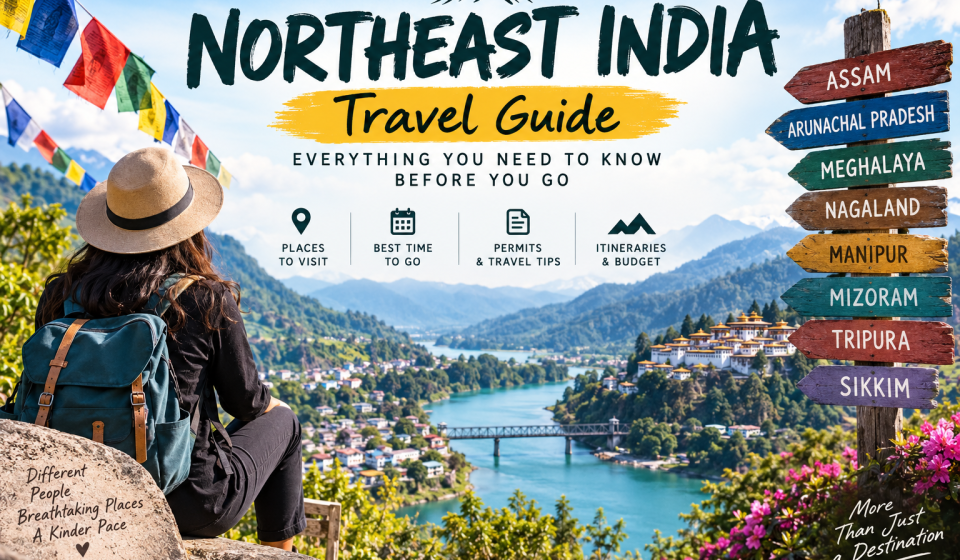

Northeast India is the kind of place where a 4-hour drive can turn into an 8-hour day, a short walk can end at a waterfall, and your dinner might be something you’ve never tried before.
The region covers 8 states: Assam, Arunachal Pradesh, Meghalaya, Nagaland, Manipur, Mizoram, Tripura, and Sikkim. Each one feels different, and trying to squeeze several of them into one rushed trip usually isn’t worth it.
If you’re planning your first Northeast India trip, this guide will help you figure out where to go, when to go, how much time you need, what permits you might need, and what to expect once you’re there.
Where should you go in Northeast India?
Start with the kind of trip you want.
Assam is a good entry point for wildlife, tea gardens, river landscapes and access to several other states. Guwahati is the main gateway for many travellers.
Meghalaya is the easy recommendation for a first trip. Shillong, Cherrapunji, Dawki, Mawlynnong and the living root bridges give you a good mix of hills, waterfalls, villages and forests.
Arunachal Pradesh is for bigger landscapes and longer road journeys. Tawang, Dirang, Bomdila, Ziro and Mechuka are among the places travellers commonly plan around.
Nagaland is a great choice if you’re interested in Naga culture, villages, food and festivals. Kohima and the Hornbill Festival are usually the first things people look at.
Sikkim works well if you want mountain scenery without planning an extremely long trip. Gangtok, Pelling, Lachung, Yumthang and Tsomgo Lake are popular choices.
Then there are Mizoram, Manipur and Tripura, each with their own landscapes and cultures. They need more planning depending on where you want to go.
The Ministry of Tourism’s Incredible India portal currently lists all 8 Northeastern states separately, so it’s worth checking the state-specific information before fixing your route.
How many days do you need?
This depends heavily on your route.
For a first trip, I’d plan something like:
- 4-5 days: Meghalaya
- 6-7 days: Assam + Meghalaya
- 7-9 days: Arunachal Pradesh, focused on Tawang
- 6-8 days: Sikkim
- 5-7 days: Nagaland
- 10-14 days: A more serious Northeast trip covering 2-3 states
Road distances can be misleading here.
Google Maps might tell you two places are 150 km apart. That doesn’t mean you’ll get there in 3 hours.
Mountain roads, rain, traffic, construction, landslides and regular stops can stretch the journey considerably. Build some breathing room into your itinerary.
When is the best time to visit?
There isn’t one perfect month for the entire Northeast.
October to April is generally a comfortable period for many popular routes, especially if you’re interested in clear mountain views and road travel.
Winter can get properly cold in the higher areas of Arunachal Pradesh and Sikkim. Pack accordingly.
March to May can be excellent for greenery, flowers and pleasant temperatures in several places.
Then comes the monsoon.
Meghalaya receives enormous amounts of rain, and that rain is part of what makes the region so beautiful. But heavy rain can also affect roads, trekking routes and waterfalls.
If you’re visiting during the monsoon, check local weather and road conditions before leaving each morning.
Northeast India during monsoon
Don’t automatically cancel a trip because of rain.
Some places are at their best during or just after the rains. Meghalaya is the obvious example.
The catch is transportation.
A road can be perfectly usable when you leave Shillong and become difficult several hours later. Give yourself extra time, keep your accommodation flexible where possible, and avoid planning important flights immediately after a long mountain drive.
Carry a proper rain jacket. An umbrella alone won’t save you when the rain decides to get serious.
Do you need permits?
This is one of the first things you should check before booking anything.
Arunachal Pradesh requires an Inner Line Permit for Indian visitors entering the state. The process and rules can change, so check the official state portal before your trip.
Nagaland also has an Inner Line Permit system. The state moved its ILP application process online, and tourist ILPs are available through the official system. The government also operates tourist information and ILP facilitation counters at Dimapur.
The current Nagaland guidelines list tourist ILPs with a 30-day validity, including separate requirements and fees for domestic and foreign visitors. Check the latest notification before travelling because permit rules can change.
Sikkim has its own permit requirements for certain protected and restricted areas. Places such as North Sikkim and the Nathula area need additional planning, and permit conditions can change according to weather and local orders.
Check permits before you book non-refundable travel. That’s a 5-minute job that can save you a very annoying day later.
How do you get around?
For many Northeast trips, your vehicle matters almost as much as your hotel.
Trains and flights can get you close to your destination. After that, road travel becomes a big part of the trip.
Shared taxis are common.
Private cabs are easier if you’re travelling with family or friends because you control the stops and timing. They’re also useful when your itinerary includes several remote places.
Buses are available on many routes, but schedules and journey times can vary.
For mountain destinations, I’d rather pay a little more for a good local driver than save money and spend the whole journey worrying about the road.
Local drivers know where the road gets rough, where you can stop for food, and which route makes sense that day.
Should you rent a car?
It depends on the state.
In places such as Meghalaya, a private car with a driver is often the easiest option for a sightseeing-heavy trip.
In Sikkim and Arunachal Pradesh, local transport arrangements can make more sense for certain restricted or mountain routes.
Self-driving can be enjoyable if you’re experienced with mountain roads. If you aren’t, don’t learn on a road where the next petrol station might be several hours away.
What should you pack?
Keep it practical.
- Comfortable walking shoes
- Light clothes for lower-altitude areas
- Warm layers for mountains
- Rain jacket
- Small backpack
- Power bank
- Basic medicines
- Sunscreen
- Reusable water bottle
- Government ID
- Copies of permits and bookings
- Some cash
Don’t pack your entire house.
You’ll be moving between hotels, cars and towns, and a giant suitcase becomes annoying very quickly.
Carry cash
UPI works in many parts of the Northeast, especially in towns and tourist areas.
Remote villages are a different story.
Network problems, power cuts and small businesses without digital payment options can still happen. Keep some cash with you, especially before heading into remote areas.
Don’t wait until you’re standing in a village with ₹37 left in your wallet to discover the nearest ATM is 60 km away.
Mobile network and internet
Major towns generally have decent connectivity.
Remote mountain areas can be unpredictable.
Download offline maps before leaving your hotel. Save your hotel address, driver number, permits and important bookings on your phone.
A power bank is worth carrying every day.
If you’re travelling into remote Arunachal Pradesh, Nagaland, Mizoram or other less-connected areas, tell someone your planned route before you leave.
Food you should try
Food is one of the best reasons to slow down in Northeast India.
Assamese food has its own character, with dishes such as khar, tenga and pitha.
Meghalaya is known for Khasi and Jaintia dishes, including jadoh and different preparations of pork.
Nagaland is famous for dishes using smoked meat, fermented ingredients and local chillies. Naga food can be seriously spicy, so ask before ordering if you’re sensitive to heat.
You’ll also find momos, thukpa, noodles and other dishes influenced by neighbouring regions.
Try local food from proper local restaurants and homestays when you can. That’s usually where you’ll get a better sense of what people actually eat.
Respect local customs
The Northeast isn’t one culture.
Every state has its own communities, languages, food traditions and social customs.
Ask before photographing people, homes, ceremonies or religious places.
Dress appropriately in villages and sacred places. Follow local instructions when entering community-managed areas.
And learn a few local words if you’re staying somewhere for more than a night. Even a simple greeting can change the mood of an interaction.
Homestays can be worth it
Hotels are easy.
Homestays can give you a completely different trip.
You might have breakfast with the family, hear stories about the village, get better local food recommendations and learn which nearby places are actually worth visiting.
Just keep your expectations realistic. A homestay in a remote village may have limited hot water, weaker Wi-Fi or fewer amenities than a city hotel.
That’s part of the deal.
How much does a Northeast India trip cost?
Your budget depends heavily on the state and how you travel.
A rough daily planning range for an Indian traveller could look like this:
| Travel style | Approx. daily budget |
|---|---|
| Budget | ₹1,500-₹2,500 |
| Mid-range | ₹3,000-₹6,000 |
| Comfortable | ₹6,000-₹10,000+ |
These numbers can move quite a bit once you add private vehicles, flights, permits, activities and peak-season accommodation.
A private car can become one of the biggest expenses on a road trip, especially when you’re covering long distances.
Travelling with 3-4 people can make the vehicle cost much easier to handle.
A few routes I’d consider
1. Meghalaya for first-time visitors
Guwahati → Shillong → Cherrapunji/Sohra → Dawki → Shillong → Guwahati
Give it around 5-6 days.
This is probably the easiest introduction to the region if you want waterfalls, hills, caves, villages and scenic drives without planning a huge multi-state trip.
2. Assam + Meghalaya
Guwahati → Kaziranga → Shillong → Sohra → Dawki → Guwahati
Plan around 7-9 days.
This gives you wildlife and tea-country scenery in Assam, followed by the hills and waterfalls of Meghalaya.
3. Arunachal Pradesh
Guwahati → Bhalukpong → Bomdila → Dirang → Tawang
Give yourself around 7-9 days.
The journey is a major part of the experience. Don’t try to turn this into a race.
4. Sikkim
Bagdogra/NJP → Gangtok → Tsomgo Lake/Nathula → Pelling or North Sikkim → return
Around 7-9 days works well for a first trip, depending on the route and permits.
North Sikkim requires extra attention to current road and permit conditions. The state government has issued route-specific requirements for destinations such as Lachung and Yumthang.
5. Nagaland
Dimapur → Kohima → Khonoma → nearby villages → Dimapur
Around 5-7 days is a comfortable starting point.
If you’re visiting during the Hornbill Festival, book accommodation and transport well in advance.
Things I wish more travellers planned for
Don’t overpack your itinerary.
Northeast India rewards slow travel. If you spend 6 hours in a car every day just to tick places off a list, you’ll miss a lot of what makes the journey special.
Don’t assume a map gives you the full story.
Road conditions change. Weather changes. Local restrictions change.
Ask your driver or hotel about the next day’s route before you leave.
Don’t leave permits until the last minute.
Some areas have restricted access, and permit requirements can change.
Don’t treat villages like photo sets.
People live there. Ask before taking close-up photographs, especially of children, homes, ceremonies and religious activities.
Don’t underestimate the weather.
A sunny morning doesn’t guarantee a dry afternoon in the hills.
Carry a rain layer even when the sky looks completely harmless.
Is Northeast India safe for tourists?
For most travellers, yes, but basic travel sense still matters.
The bigger risks on many routes are road conditions, weather, altitude, remote locations and delayed transport.
Keep someone informed about your route when travelling into remote areas.
Use registered accommodation and trusted local transport where possible. Follow local instructions around restricted areas and border regions.
And if a local driver tells you that a particular road shouldn’t be attempted today because of weather, listen to them.
They’ve probably driven it more times than you have.
The biggest mistake you can make
Trying to see all of Northeast India in one trip.
You can’t properly experience 8 states in 10 days.
Pick one state, or combine 2 that naturally fit together. Spend more time in fewer places. Leave a spare day when your route involves long mountain drives.
You’ll come home with fewer checkmarks on Google Maps and a much better memory of the trip.
That’s a trade I’d take every time.
Final planning checklist
Before you leave, check:
- State-specific permits
- Weather forecast
- Road conditions
- Hotel bookings
- Transport and driver
- Flight/train timings
- Cash
- Offline maps
- Mobile connectivity
- Emergency contacts
- Government ID
- Copies of permits
- Local restrictions
- Travel insurance
And save the official tourism information for the states you’re visiting. Rules around permits, restricted areas and road access can change, so old travel blogs aren’t always reliable.
The Northeast is a region I’d rather revisit than rush through.
Pick your route carefully, leave some space in the schedule, talk to locals, eat the food, and let the road take a little longer than Google promised.
Featured Image Credit: Generated/Sourced via Chatgpt.com.
Editorial note: Some articles may use AI-assisted research or drafting. Our editorial process includes human review and editing, and important travel information should be verified with official sources before your trip.
Travel Tips & Responsible Exploration
Good travel planning starts with staying informed. Before your journey, verify important details such as transportation, accommodation, weather, permits, entry requirements, and local guidelines. Respect local communities, cultures, traditions, and the environment, and travel responsibly wherever you go. Suman Rabha shares practical travel guides, local insights, and destination information to help readers explore Northeast India and beyond with greater confidence.