
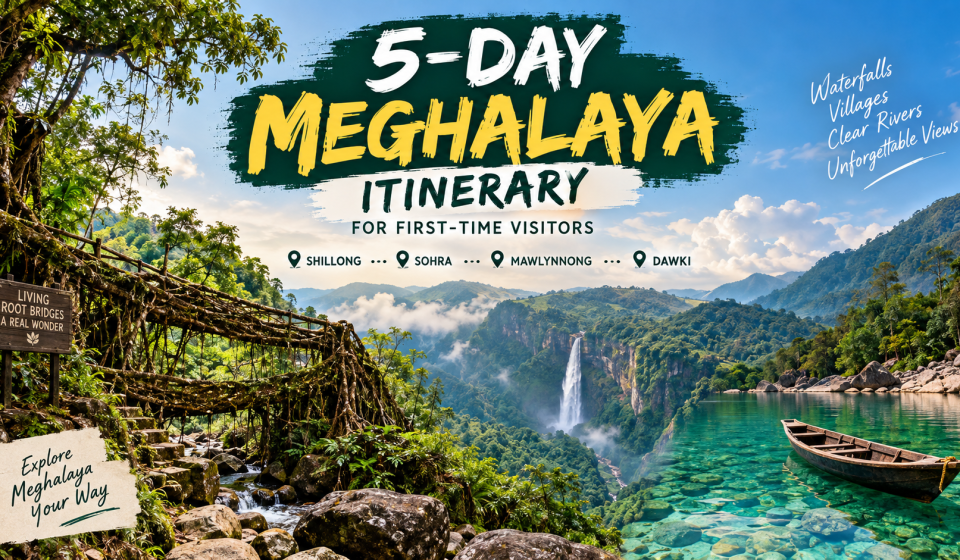

Meghalaya is one of those places where the road itself becomes part of the trip.
You leave Guwahati, climb into the Khasi Hills, and suddenly the scenery changes. Pine forests, clouds hanging over valleys, roadside waterfalls, tiny villages, and roads disappearing into mist.
For a first trip, 5 days is enough to see the classic Meghalaya circuit without spending the whole holiday inside a car.
This route covers Shillong, Sohra, Mawlynnong, Dawki and a few of the best stops around them.
Meghalaya at a glance
Duration: 5 days / 4 nights
Best starting point: Guwahati
Main route: Guwahati → Shillong → Sohra → Mawlynnong → Dawki → Shillong/Guwahati
Best for: First-time visitors, couples, families and small groups
Recommended transport: Private cab
The distances in Meghalaya look short on Google Maps. Travel times can still be long because you’re driving through hills, winding roads and small towns.
So plan your days around places that sit on the same route, rather than trying to collect every attraction on a map.
Day 1: Guwahati to Shillong
Start early from Guwahati.
The drive to Shillong takes roughly 3 to 4 hours depending on traffic and stops. Once you reach Shillong, check into your hotel and keep the afternoon relaxed.
Shillong is around 100 km from Guwahati, and it’s the easiest base for exploring the surrounding Khasi Hills.
What to see in Shillong
Start with Ward’s Lake if you arrive early enough. It’s right in the city and works well for a relaxed walk after the drive.
Then head towards Shillong Peak for a view over the city and surrounding hills.
If you’re interested in Northeast India’s tribal cultures, keep some time for the Don Bosco Museum. Give yourself at least 1-2 hours here.
Later, walk around Police Bazaar for food and shopping.
Shillong has plenty of cafés, bakeries and small restaurants, so this is a good evening to eat something local and take it easy.
Stay
Stay in Shillong.
Day 1 route:
Guwahati → Shillong
Day 2: Shillong to Sohra
Leave Shillong after breakfast and drive towards Sohra, formerly known as Cherrapunji.
Sohra is about 55 km from Shillong, but don’t rush the drive. The road has viewpoints and several places worth stopping at. (Meghalaya Tourism)
Your first proper stop can be Mawkdok Dympep Valley.
The huge valley opens up in front of you almost immediately. There’s also zip-lining here if you’re in the mood for something more adventurous.
Continue towards Sohra.
Nohkalikai Falls
This should be high on your list.
Nohkalikai Falls drops about 340 metres into a blue-green pool and is around 7.5 km from Sohra. (Meghalaya Tourism)
Give yourself time at the viewpoint. The falls can look completely different depending on the weather.
Mawsmai Cave
Next, visit Mawsmai Cave.
It’s an easy introduction to Meghalaya’s limestone caves and doesn’t require the kind of trek you’d need for some of the more demanding cave systems.
Seven Sisters Falls
End the sightseeing day at Nohsngithiang Falls, better known as Seven Sisters Falls.
The falls drop more than 300 metres from the plateau, and the monsoon months bring a huge amount of water over the cliff. (Meghalaya Tourism)
If you’re visiting during the wetter months, this is one of those stops where weather can completely change the experience.
Stay
Stay in Sohra.
You can find hotels, resorts and homestays around Sohra. Booking ahead is sensible during busy periods. (Meghalaya Tourism)
Day 3: Sohra and Nongriat
This is your most active day.
Start early and head towards Nongriat for the famous Double-Decker Living Root Bridge.
The trek involves a lot of stairs. A lot.
You’ll be walking through forest, crossing smaller bridges and descending into the valley before reaching the root bridge.
Take water, proper shoes and enough time. Don’t treat this like a quick sightseeing stop.
The living root bridges around Sohra are created by guiding the roots of rubber fig trees over years until they form usable bridges. Meghalaya Tourism lists both single and double-decker root bridges around the region. (Meghalaya Tourism)
If you’re reasonably fit, this can easily become the favourite day of your trip.
After the trek
Return to Sohra and keep the evening slow.
You’ve earned it.
Have dinner at your hotel or a local restaurant and get some sleep.
Stay
Stay in Sohra for another night.
Day 3 route:
Sohra → Nongriat → Sohra
Day 4: Sohra to Mawlynnong to Dawki
Get an early start.
Today takes you towards the India-Bangladesh border, with stops at Mawlynnong and Dawki.
Mawlynnong is around 76 km from Shillong, and the village is known for its cleanliness, gardens and living root bridge. (Meghalaya Tourism)
Mawlynnong
Walk around the village rather than simply arriving, taking a photo and leaving.
Visit the Nohwet Living Root Bridge, then check out the bamboo Sky Viewpoint for views towards the Bangladesh plains.
There’s also the old Church of the Epiphany, surrounded by gardens. (Meghalaya Tourism)
Have lunch in the area and continue towards Dawki.
Dawki and the Umngot River
Dawki is famous for the Umngot River, especially when the water is clear enough to see the riverbed beneath the boat.
You can take a boat ride or continue towards Shnongpdeng, where you’ll find riverside stays and outdoor activities.
Meghalaya Tourism specifically groups Mawlynnong, Dawki and Shnongpdeng into a popular day route from Shillong. (Meghalaya Tourism)
If you’re visiting during a period when river activities are running, check local conditions before booking. Weather and water levels matter here.
Stay
For a relaxed trip, stay in Shnongpdeng.
If you prefer better hotel choices and don’t mind another drive, return to Shillong.
I’d pick Shnongpdeng. Sitting beside the river after a long day is a much better ending.
Day 5: Shnongpdeng to Shillong and Guwahati
Wake up early if you’re staying in Shnongpdeng.
Have breakfast by the river, take a short walk and start your return journey.
If your flight or train from Guwahati is late in the evening, you can stop at Shillong for lunch and a final coffee before continuing to Guwahati.
If you’ve already seen Shillong properly on Day 1, don’t spend half the day repeating the same sights.
Use the time for food, shopping or simply getting back to Guwahati without rushing.
Your 5-day route
| Day | Route | Main sights | Stay |
|---|---|---|---|
| 1 | Guwahati → Shillong | Ward’s Lake, Shillong Peak, Don Bosco Museum, Police Bazaar | Shillong |
| 2 | Shillong → Sohra | Mawkdok, Nohkalikai Falls, Mawsmai Cave, Seven Sisters Falls | Sohra |
| 3 | Sohra → Nongriat → Sohra | Double-Decker Living Root Bridge | Sohra |
| 4 | Sohra → Mawlynnong → Dawki | Living Root Bridge, Sky Viewpoint, Umngot River, Shnongpdeng | Shnongpdeng |
| 5 | Shnongpdeng → Shillong → Guwahati | River morning, Shillong stop | — |
Best time for this Meghalaya itinerary
Your choice of month changes the trip quite a bit.
October to March is better for comfortable sightseeing, road trips and trekking. Meghalaya Tourism recommends the drier months for Sohra hikes and outdoor activities. (Meghalaya Tourism)
June to September is the monsoon season.
This is when Sohra’s waterfalls can become enormous. Seven Sisters Falls, in particular, gets its full monsoon character during this period. (Meghalaya Tourism)
But rain can also affect roads, visibility and trekking conditions.
So if your priority is waterfalls, pick the monsoon. If you want easier driving and trekking, October to March makes more sense.
How to travel around Meghalaya
For a first trip, I’d book a private cab with a driver.
It gives you control over when you stop, which matters because Meghalaya is full of roadside viewpoints and small places that aren’t part of a fixed tour itinerary.
Shared taxis work for travellers on a tighter budget, and Shillong has transport connections to places such as Sohra and Mawlynnong. (Meghalaya Tourism)
But for 4-5 people, a private vehicle can make the maths much more reasonable.
Where to stay
Keep it simple.
Night 1: Shillong
Night 2: Sohra
Night 3: Sohra
Night 4: Shnongpdeng
This saves you from changing hotels every night and keeps the route sensible.
Sohra has everything from resorts to smaller homestays, while Shnongpdeng is the better choice if you want a riverside night. (Meghalaya Tourism)
What to pack
Meghalaya weather can change quickly, so pack accordingly.
- Lightweight rain jacket
- Small umbrella
- Comfortable walking shoes
- Sandals or quick-dry footwear
- Extra socks
- Power bank
- Reusable water bottle
- Small backpack for the Nongriat trek
- Basic medicines
- Cash for smaller shops and local stops
And keep your phone in a waterproof pouch.
You’ll thank me later.
How much does 5 days in Meghalaya cost?
For 2 people, a reasonable mid-range budget is roughly:
| Expense | Approx. cost for 2 |
|---|---|
| Guwahati–Meghalaya cab | ₹12,000–₹18,000 |
| Hotels for 4 nights | ₹8,000–₹16,000 |
| Food | ₹5,000–₹8,000 |
| Sightseeing, parking, activities | ₹3,000–₹6,000 |
| Miscellaneous | ₹2,000–₹4,000 |
| Estimated total | ₹30,000–₹52,000 |
Your actual cost will depend heavily on the vehicle, hotel category, season and whether you add activities such as boating or zip-lining.
For 4 people sharing one vehicle, the per-person transport cost drops considerably.
A few things I’d change for different travellers
With kids: Skip Nongriat if the trek looks too demanding. Spend another day around Sohra instead.
For couples: Keep Night 4 in Shnongpdeng. The riverside stay is worth it.
For photographers: Give Sohra more time. Nohkalikai, Seven Sisters and the surrounding valleys can easily fill another day.
For adventure: Keep Nongriat and add more trekking around Sohra.
For a relaxed trip: Drop one destination. Meghalaya gets tiring when every day becomes a race against Google Maps.
The route I’d personally pick
Guwahati → Shillong → Sohra → Nongriat → Mawlynnong → Dawki → Shnongpdeng → Guwahati
It gives you a good first taste of Meghalaya without trying to cover the whole state in 5 days.
And that’s the trick with Meghalaya. Leave some empty space in the itinerary. The best stop might be the one you didn’t plan.
Featured Image Credit: Generated/Sourced via Chatgpt.com.
Editorial note: Some articles may use AI-assisted research or drafting. Our editorial process includes human review and editing, and important travel information should be verified with official sources before your trip.
Travel Tips & Responsible Exploration
Good travel planning starts with staying informed. Before your journey, verify important details such as transportation, accommodation, weather, permits, entry requirements, and local guidelines. Respect local communities, cultures, traditions, and the environment, and travel responsibly wherever you go. Suman Rabha shares practical travel guides, local insights, and destination information to help readers explore Northeast India and beyond with greater confidence.