
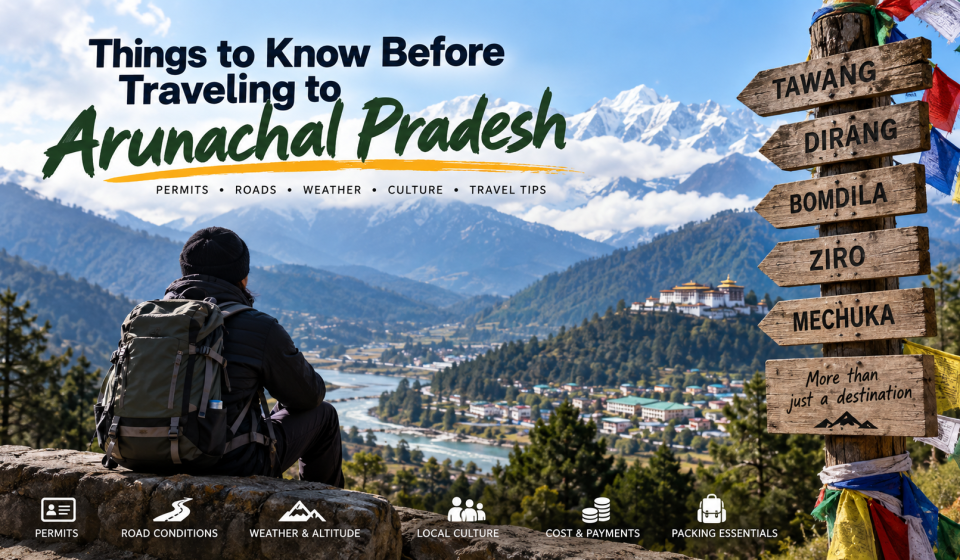

Arunachal Pradesh rewards people who give the journey some breathing room.
Distances look harmless on Google Maps. Then you spend 6 hours covering 150 km because the road climbs through mountains, drops into valleys, and occasionally decides to become a construction site.
So before you book your hotel and start planning Instagram shots, there are a few things you should know.
1. Arunachal Pradesh is a permit state
Indian travelers need an Inner Line Permit (ILP) to enter Arunachal Pradesh.
You can apply online before the trip, and you should carry the permit with you. Keep a couple of printed copies too. Phone batteries have a funny habit of dying exactly when you need to show a document.
Foreign nationals have different entry requirements, so check the current rules before planning your route.
2. Don’t underestimate the distances
This is probably the biggest planning mistake.
A route that looks like 200 km can take most of a day. Mountain roads are slow, and weather, roadwork, landslides, traffic, and military movement can add more time.
If you’re planning Guwahati → Bhalukpong → Bomdila → Dirang → Tawang, for example, don’t treat each leg like a normal highway journey.
Give yourself buffer time.
3. Roads can change your itinerary
Arunachal’s roads are constantly being repaired, widened, cleared, or rebuilt.
A route that’s perfectly fine when you leave can look very different after heavy rain or a landslide.
Check local road conditions before leaving each morning, especially if you’re traveling toward Tawang, Bum La, Ziro, or remote parts of the state.
And if a local driver tells you a particular road will take longer than Google says, listen to the driver.
4. Start your drives early
Mountain travel works better when you start early.
You get more daylight, more time for unexpected stops, and a better safety margin if something slows you down.
I generally prefer reaching the next town before evening rather than squeezing in one more sightseeing stop and arriving after dark.
Some mountain roads are simply better experienced in daylight.
5. Mobile network can disappear
Don’t expect continuous connectivity.
BSNL can be useful in places where other networks disappear, while coverage varies heavily between towns and remote areas.
Download your maps before leaving.
Save hotel details, permits, important phone numbers, and your route offline too. A screenshot can be surprisingly useful when your phone suddenly says Emergency calls only.
6. Carry cash
UPI works in many towns and tourist areas, but Arunachal isn’t a place where I’d travel with only digital payment options.
ATMs aren’t equally convenient everywhere, and remote areas can have limited banking facilities.
Carry enough cash for fuel, food, accommodation, permits, local transport, and unexpected expenses.
Keep some smaller notes. A ₹500 note isn’t much use when you’re trying to buy a ₹40 bottle of water from a roadside shop.
7. Weather changes quickly
Mountain weather has its own plans.
A sunny morning can turn cold and wet within a few hours, particularly at higher elevations.
Pack layers rather than one giant jacket. A light rain jacket, warm layer, comfortable shoes, sunglasses, sunscreen, and a small umbrella are useful.
If you’re going to Tawang or Bum La, pack properly for cold conditions even if the weather in Guwahati feels warm.
8. Altitude becomes a real issue around Tawang
Tawang sits at roughly 10,000 ft, and places such as Bum La are much higher.
Give your body time to adjust.
Don’t plan an exhausting schedule immediately after reaching Tawang. Drink water, eat properly, sleep well, and take it easy if you develop a headache, dizziness, nausea, unusual fatigue, or breathing difficulty.
Symptoms that become severe or keep getting worse need medical attention.
9. Bum La needs separate planning
Bum La is near the India-China border and has additional restrictions.
You generally need permission to visit, and arrangements are handled locally through the appropriate authorities and usually your driver or tour operator.
Weather can also shut the route.
So don’t build your entire Tawang trip around the assumption that you’ll definitely reach Bum La on a particular morning.
10. Don’t rush Tawang
Tawang deserves several days.
You have the monastery, old town, lakes, viewpoints, war memorial, surrounding villages, and high-altitude excursions. The journey itself also takes time.
A 2-night Tawang itinerary can feel like you’ve spent most of your holiday sitting inside a vehicle.
I’d give Tawang 3 nights or more if your schedule allows it.
11. Ziro is a different kind of trip
Ziro isn’t simply another stop to tick off.
The valley is about slowing down, walking around villages, looking at the Apatani agricultural landscape, eating local food, and spending time without trying to fill every hour.
If you like quiet places and cultural travel, give Ziro enough time.
12. Respect local customs
Arunachal is home to many tribes, each with its own traditions, languages, food, architecture, and customs.
Ask before photographing people, homes, ceremonies, or religious places.
And don’t treat villages like open-air museums. You’re visiting someone’s home area.
A little courtesy goes a long way.
13. Alcohol rules can vary
Arunachal Pradesh has had changing rules around alcohol, and restrictions can differ depending on local regulations and circumstances.
Don’t assume something is available simply because you found an old travel blog saying it was.
Check current local rules and buy only from legal sources.
14. Food can be wonderfully different
You’ll find familiar Indian food in most tourist towns, but Arunachal is a good place to try local dishes.
Thukpa, momos, zan, bamboo-shoot preparations, smoked meats, local rice dishes, and tribal cuisines vary considerably by region.
Tell the restaurant if you can’t handle very spicy food.
And carry a few snacks during long drives. You might go a surprisingly long stretch before finding a proper restaurant.
15. Don’t expect luxury everywhere
Hotels in places such as Tawang, Bomdila, Dirang, and Ziro range from basic guesthouses to comfortable properties.
Remote areas have fewer choices.
Hot water, heating, Wi-Fi, room service, and restaurant hours can be less predictable than in major cities. Check what your hotel actually provides before paying.
A good room heater can suddenly become your favourite hotel amenity.
16. Carry the right vehicle
For mountain routes, your vehicle matters.
A local driver who knows the roads is worth paying for, especially for longer routes and difficult sections.
For Tawang, ask about the vehicle before booking. A comfortable SUV with an experienced mountain driver can make a huge difference on a long road journey.
Self-driving also requires more confidence than simply knowing how to drive a car. Mountain roads, fog, narrow sections, falling rocks, and unpredictable traffic aren’t beginner territory.
17. Keep your itinerary flexible
Build one buffer day into a longer Arunachal trip if you can.
A delayed departure, roadblock, landslide, vehicle problem, bad weather, or permit issue can throw off a tightly packed itinerary.
If you’ve booked flights or trains immediately after your return from the mountains, leave some margin.
You don’t want your entire trip depending on a mountain road being open at exactly 9:00 AM.
18. Fuel planning matters
Fuel stations aren’t everywhere.
Fill up whenever you’re in a reliable town with a petrol pump, particularly before heading toward remote areas.
Your driver will usually know where the practical fuel stops are. Ask before starting a long mountain section.
19. Pack light
You’re going to move around.
Dragging 3 large suitcases through hotels, vehicles, stairs, and mountain towns gets old quickly.
One medium suitcase or backpack plus a daypack is plenty for most trips.
Keep your warm clothes accessible. Don’t bury your jacket under everything else just because the morning started sunny.
20. Don’t litter
This one should be obvious, but mountain tourism has a waste problem.
Carry your wrappers and bottles until you find a proper bin.
Avoid single-use plastic where you can, especially in remote areas where waste collection is limited.
The mountain doesn’t need your chips packet.
21. Photography needs some common sense
Arunachal is full of places where you’ll want to stop every 10 minutes.
Do it when it’s safe.
Don’t stop vehicles in narrow bends just for a photograph. Avoid photographing military installations, checkpoints, personnel, or restricted infrastructure unless you’re explicitly allowed to.
And ask permission before photographing local people.
22. Carry a basic travel kit
I wouldn’t leave for Arunachal without:
- Government ID
- ILP and copies
- Cash
- Power bank
- Offline maps
- Basic medicines
- Personal prescriptions
- Sunscreen
- Sunglasses
- Rain jacket
- Warm layers
- Comfortable walking shoes
- Reusable water bottle
- Small snacks
- Torch
- Essential toiletries
A small first-aid kit is useful too.
23. The best season depends on where you’re going
Arunachal is huge, so there’s no single perfect month for every destination.
For the Tawang circuit, spring and autumn are popular for clearer weather and generally better road conditions. Winter brings snow and serious cold at higher elevations, while the monsoon can bring heavy rain, landslides, and road disruptions.
Ziro, Mechuka, Anini, Tawang, Namdapha, and other parts of Arunachal can have very different conditions at the same time.
Choose the season around your route.
24. Give yourself more time than Google suggests
This deserves repeating.
If Google Maps says a mountain journey takes 5 hours, don’t automatically build a 5-hour schedule around it.
Plan for stops, meals, road conditions, traffic, weather, and the inevitable moment when you pull over because the view is ridiculous.
That’s part of the trip.
25. Arunachal isn’t a checklist destination
You can visit Tawang, Bum La, Sela Pass, Dirang, Bomdila, Ziro, and a dozen other places.
But trying to cram everything into 5 days usually turns the holiday into a road marathon.
Pick a circuit and give it room.
Tawang + Dirang + Bomdila works well for a first trip. Ziro + Itanagar makes more sense if you want a shorter cultural and valley-focused journey. For a longer trip, you can go deeper into places such as Mechuka or eastern Arunachal.
The roads are part of Arunachal. The weather is part of Arunachal. The occasional plan that falls apart halfway through the day is part of Arunachal too.
Plan carefully, then leave some space for the mountains to have their say.
Featured Image Credit: Generated/Sourced via Chatgpt.com.
Editorial note: Some articles may use AI-assisted research or drafting. Our editorial process includes human review and editing, and important travel information should be verified with official sources before your trip.
Travel Tips & Responsible Exploration
Good travel planning starts with staying informed. Before your journey, verify important details such as transportation, accommodation, weather, permits, entry requirements, and local guidelines. Respect local communities, cultures, traditions, and the environment, and travel responsibly wherever you go. Suman Rabha shares practical travel guides, local insights, and destination information to help readers explore Northeast India and beyond with greater confidence.