
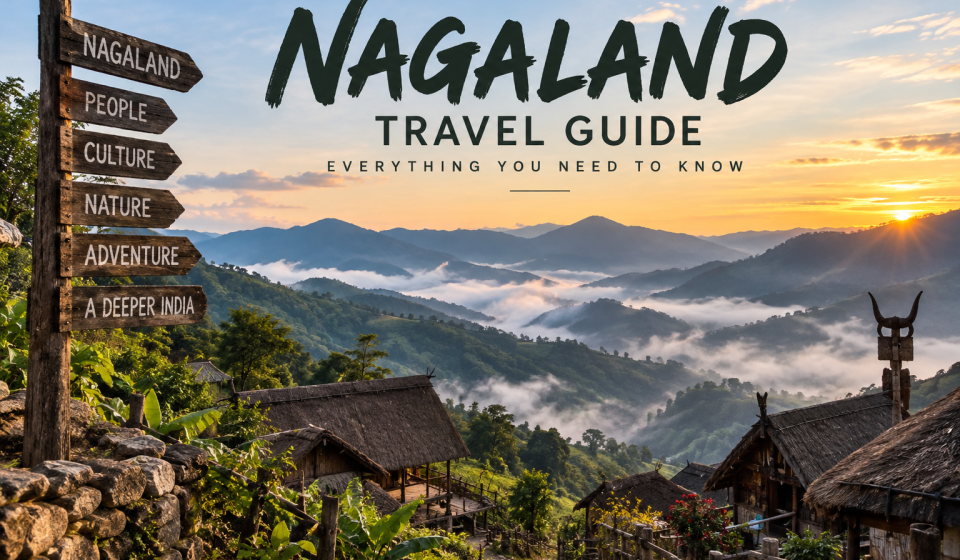

Nagaland is the kind of place where the road becomes part of the trip.
You drive through hills, stop at villages, eat food you’ve probably never tried before, and suddenly find yourself staring across a valley with no other tourist in sight.
Kohima gives you the first taste. Then Nagaland keeps getting quieter, wilder and more interesting.
If you’re planning your first trip, here’s what you actually need to know.
Why visit Nagaland?
Nagaland has a strange ability to make a short trip feel much longer.
The hills are beautiful, but the villages are what give the journey its character. Each area has its own Naga community, food, traditions and festivals.
And then there’s the food. Smoked pork, axone, bamboo shoot, sticky rice, fermented ingredients and fiery chutneys show up everywhere.
If you like trying local food, come hungry.
Best places to visit in Nagaland
Kohima
Start here.
Kohima is Nagaland’s capital and the easiest base for exploring the surrounding hills. Give yourself at least 2 days.
Visit the Kohima War Cemetery, walk around the local markets, spend time at the Naga Heritage Village at Kisama, and take a day trip to nearby villages.
Khonoma
Khonoma is around 20 km from Kohima and makes an excellent day trip.
The village is known for its history, terraced fields and conservation work. The Khonoma Nature Conservation and Tragopan Sanctuary was established in 1998.
Take your time here. Walk through the village, talk to your guide and look at the way the houses and farms sit against the hills.
Dzükou Valley
If you enjoy hiking, put Dzükou near the top of your list.
The valley sits between Nagaland and Manipur and is known for rolling grasslands, seasonal flowers, streams and mountain views.
You’ll need proper shoes, water and enough time for the trek.
Kisama Heritage Village
Kisama is where the famous Hornbill Festival is held.
The heritage village is about 12 km from Kohima and contains traditional-style morungs representing different Naga tribes.
Outside festival season, it’s still worth visiting if you’re interested in Naga culture.
During Hornbill, though, the place gets a completely different energy.
Mokokchung
Mokokchung is the cultural heartland of the Ao Naga community.
It’s a good choice if you want village life, local food and a slower trip away from the Kohima circuit.
Mon and Longwa
Head towards Mon if you want a very different side of Nagaland.
Longwa, near the Myanmar border, is the place many travellers have in mind when they picture a remote Nagaland trip.
The journey takes time, roads can be rough and distances on a map don’t tell the whole story.
Wokha and Doyang
Wokha is worth considering for its hills, countryside and birdlife.
Doyang Reservoir is especially interesting between October and November, when migratory Amur Falcons arrive in large numbers.
Best time to visit Nagaland
For a first trip, I’d pick October to April.
October and November are particularly good if you’re interested in the Amur Falcons around Doyang.
December is the big one because of the Hornbill Festival, held from December 1 to 10.
What about the monsoon?
Nagaland gets heavy rain, and the hills can become much harder to travel through.
The upside is obvious once you see the countryside. Everything turns intensely green, waterfalls get stronger and the hills look completely different.
Hornbill Festival
Hornbill Festival takes place at Kisama near Kohima every year from December 1 to 10.
You’ll see traditional performances, food, crafts, music and events connected with different Naga communities.
But here’s my advice: don’t spend your entire Nagaland trip inside Kisama.
Stay in Kohima, attend the festival, then get out into the surrounding villages.
That’s where the state starts making sense.
Nagaland Inner Line Permit
This is the part you should sort out before travelling.
Nagaland requires people from outside the state, including Indian and foreign visitors, to obtain an Inner Line Permit for entry.
The government portal allows tourists to apply online.
For domestic tourists, the current checklist asks for a recent photograph and one accepted identity document such as Aadhaar, PAN, Voter ID, Bank Passbook or Ration Card.
Foreign tourists have separate requirements.
Apply through the official Nagaland ILP portal rather than relying on old travel blogs.
How to reach Nagaland
By air
Dimapur Airport is Nagaland’s main airport.
From Dimapur, continue towards Kohima by road.
By train
Dimapur has a railway station with connections towards Guwahati and the wider Indian railway network.
Taking a train to Dimapur and then hiring a taxi to Kohima is one of the simplest combinations.
By road
You can also enter Nagaland by road from Assam.
Guwahati is a common starting point for road journeys into Nagaland.
Try to do the longer hill-road sections during daylight.
How many days do you need?
4 days
- Day 1: Dimapur to Kohima
- Day 2: Kohima + Kisama
- Day 3: Khonoma
- Day 4: Kohima to Dimapur
6 days
- Day 1: Dimapur to Kohima
- Day 2: Kohima
- Day 3: Khonoma
- Day 4: Dzükou Valley
- Day 5: Mokokchung
- Day 6: Return towards Dimapur
8-10 days
Now you can slow down.
Add Mokokchung, Wokha, Mon or Longwa depending on what interests you most.
Where to stay
Kohima has the widest range of hotels, guesthouses and homestays.
For villages, look at homestays and locally run accommodation. These can give you a much better sense of daily life than staying in a generic hotel every night.
During Hornbill Festival, don’t wait until the last minute.
What to eat in Nagaland
Come prepared to eat differently.
Try:
- Smoked pork
- Pork with bamboo shoot
- Axone dishes
- Naga-style chutneys
- Fermented bamboo shoot
- Local greens
- Smoked fish
- Sticky rice
The heat can be serious.
If you’re sensitive to chilli, say so before ordering.
Nagaland travel budget
A rough budget for a comfortable independent trip:
| Expense | Approx. daily budget |
|---|---|
| Budget stay | ₹800-1,500 |
| Mid-range hotel | ₹1,500-3,500 |
| Food | ₹400-1,000 |
| Local transport | ₹300-1,000 |
| Taxi/shared transport | Highly variable |
For a 5-6 day trip, I’d keep roughly ₹12,000-₹25,000 per person, excluding flights or long-distance trains.
A private vehicle can push the cost much higher.
Things to know before you go
Carry cash. ATMs aren’t equally convenient everywhere.
Don’t rush the roads. A distance that looks tiny on Google Maps can take hours in the hills.
Ask before photographing people. Especially during village visits, ceremonies and cultural events.
Respect village rules. Your local guide or host can explain them.
Carry warm clothes. Higher areas can get properly cold in winter.
Download offline maps. Mobile connectivity can become patchy once you leave the larger towns.
Festivals worth planning around
Hornbill gets all the attention, but Nagaland has festivals throughout the year.
Sekrenyi takes place in February, Aoleang in April, Moatsu in May and Tsungremong in August.
If you’re interested in a particular Naga community, check its festival calendar before booking your trip.
Is Nagaland safe for tourists?
For normal tourism, Nagaland can be a rewarding place to travel, especially when you plan your routes properly and use local advice.
Remote areas require more preparation than Kohima.
Road conditions, weather, local restrictions and connectivity can change, so check with your accommodation or a local operator before heading into less-visited areas.
What I’d do on a first Nagaland trip
I’d fly or take the train to Dimapur, get to Kohima, and spend the first couple of days there.
Then I’d visit Khonoma, hike Dzükou Valley, spend some time in a village and finish with Mokokchung if I had enough days.
If I had 10 days, I’d seriously consider going further east.
Because that’s the thing with Nagaland. You can see the famous places in a few days. Understanding the place takes longer.
And honestly, that’s a good reason to come back.
Featured Image Credit: Generated/Sourced via Chatgpt.com.
Editorial note: Some articles may use AI-assisted research or drafting. Our editorial process includes human review and editing, and important travel information should be verified with official sources before your trip.
Travel Tips & Responsible Exploration
Good travel planning starts with staying informed. Before your journey, verify important details such as transportation, accommodation, weather, permits, entry requirements, and local guidelines. Respect local communities, cultures, traditions, and the environment, and travel responsibly wherever you go. Suman Rabha shares practical travel guides, local insights, and destination information to help readers explore Northeast India and beyond with greater confidence.