
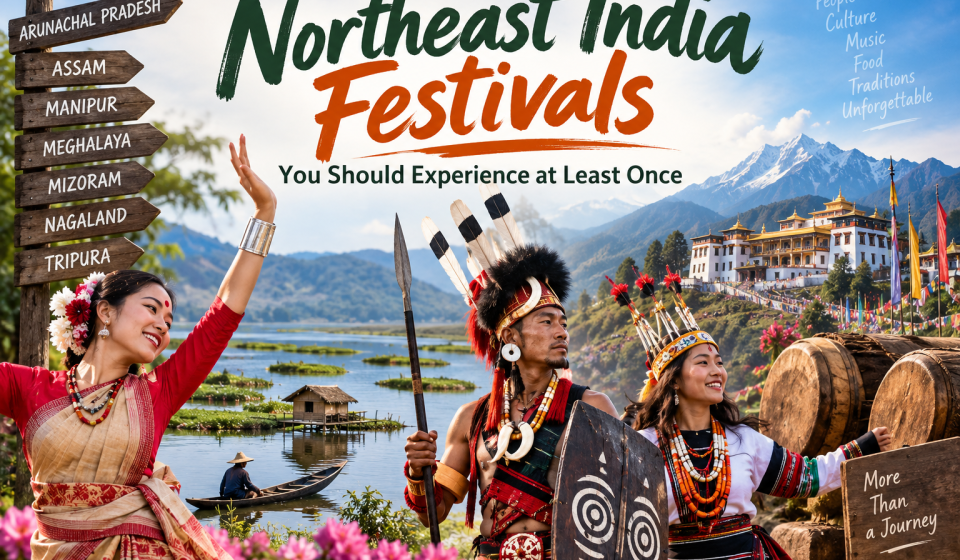

Northeast India has a way of making you slow down.
You hear drums from somewhere down the road. Someone’s cooking a dish you’ve never tried. People are dressed in traditional clothes, children are running around, and suddenly the festival you’ve come to photograph feels like something you’re actually part of.
The region has 8 states, hundreds of communities, and a ridiculous number of festivals worth planning a trip around.
Some celebrate harvests. Some honour ancestors and deities. Others bring together music, dance, food, traditional sports, and old customs that have survived for generations.
Here are the Northeast Indian festivals I’d put on your travel list.
1. Hornbill Festival, Nagaland
When: December
Where: Kisama Heritage Village, near Kohima
If you’re planning your first festival trip to Northeast India, start here.
The Hornbill Festival brings together Naga communities through traditional dances, music, food, handicrafts, games, and cultural performances. It has become one of Nagaland’s best-known annual events, with the main celebrations taking place at Kisama Heritage Village.
You’ll see colourful traditional attire, hear log drums and folk music, eat Naga food, and probably spend far longer at the food stalls than you planned.
And Kohima itself is worth adding to the trip. Give yourself a few extra days instead of treating the festival as a quick weekend stop.
2. Sangai Festival, Manipur
When: 21 to 30 November 2026
Where: Imphal and other venues in Manipur
Named after the Sangai, Manipur’s rare brow-antlered deer, the Sangai Festival is a 10-day celebration of the state’s culture. The 2026 edition is scheduled for 21 to 30 November. (Incredible India)
You’ll find folk dances, Ras Leela, handloom and handicraft displays, local food, indigenous sports, music, and performances from different communities across Manipur.
The sports are especially fun to watch. Thang Ta, Mukna Kangjei, Yubi Lakpi and Sagol Kangjei give you a very different look at Manipuri sporting traditions. (Incredible India)
If you come for Sangai, don’t stay in Imphal the whole time. Add Loktak Lake and Keibul Lamjao National Park to the trip.
3. Bihu, Assam
When: April, January and October depending on the Bihu
Where: Across Assam
Bihu is woven into Assamese life.
There are 3 major Bihus: Rongali or Bohag Bihu in April, Bhogali or Magh Bihu in January, and Kongali or Kati Bihu in October.
For travellers, Rongali Bihu is probably the one to experience first. The atmosphere changes across Assam with traditional songs, dance, feasts and community celebrations.
And yes, you should try Assamese food while you’re there. A festival trip without eating local food would be a bit like visiting Assam and refusing to look at the Brahmaputra.
4. Wangala Festival, Meghalaya
When: Usually November
Where: Garo Hills, Meghalaya
Wangala is the harvest festival of the Garo people.
It’s often called the 100 Drums Wangala Festival, which tells you roughly what you’re walking into.
Traditional drummers, dancers and performers gather to celebrate the harvest and give thanks for the year’s crops. The sound carries through the Garo Hills, and the traditional clothing makes the performances even more striking.
The festival is also a good excuse to explore Garo Hills properly. Meghalaya gets plenty of attention for Shillong and Cherrapunji, but the western part of the state deserves some road-trip time too.
5. Chapchar Kut, Mizoram
When: Usually March
Where: Aizawl and other parts of Mizoram
Chapchar Kut is one of Mizoram’s biggest traditional festivals.
It comes after the bamboo and forest clearing work associated with jhum cultivation, when people have a little breathing room before the next stage of agricultural work.
The celebration brings together traditional dances, music, clothing and food.
Mizoram is also one of those places where the journey matters. Roads wind through green hills, villages appear around corners, and Aizawl has its own distinct character.
Give yourself time.
6. Moatsu Festival, Nagaland
When: May
Where: Mainly among the Ao Naga community
Moatsu is celebrated by the Ao Naga community after the major agricultural work of the season is finished.
It’s a time for gatherings, songs, dances, food and community celebrations.
If Hornbill is Nagaland’s big public festival, Moatsu gives you a different experience. It’s closely connected with the Ao community and its agricultural traditions.
Mokokchung is the place to look at if you’re planning around Moatsu.
7. Nongkrem Dance Festival, Meghalaya
When: Usually November
Where: Smit, near Shillong
Head to Smit for the Nongkrem Dance Festival, one of the important cultural celebrations of the Khasi people.
The festival is connected with thanksgiving and prayers for prosperity and a good harvest. Traditional dances and ceremonial performances take place over several days.
The setting helps too. Smit is the traditional capital of the Khasi kingdom, and the festival gives you a reason to spend time outside Shillong.
Check the dates before booking flights because the festival follows the traditional calendar and dates can change each year. The Ministry of Tourism lists Nongkrem among Meghalaya’s recurring festivals. (Tourism India)
8. Losar, Arunachal Pradesh
When: Usually February or March
Where: Tawang and other Buddhist communities in Arunachal Pradesh
If you’ve been wanting to see Tawang, Losar can give you another reason to go.
Losar is the Tibetan Buddhist New Year and is celebrated by communities in the Himalayan parts of Arunachal Pradesh. Monasteries become important gathering points, with prayers, rituals and traditional celebrations.
Tawang is already one of the most memorable mountain destinations in India. Add winter roads, monasteries and Losar celebrations to the trip and you’ve got a very different kind of holiday.
Just check road and weather conditions before travelling. Arunachal’s mountains don’t care about your itinerary.
9. Chavang Kut, Manipur
When: 1 November
Where: Across Manipur
Chavang Kut, also called Kut or Khodou, is a harvest festival celebrated by Kuki-Chin-Mizo communities in Manipur.
The festival takes place on 1 November and includes traditional music, dance, clothing, food and community gatherings. (Incredible India)
It’s one of those festivals where you get a better sense of Manipur’s cultural diversity by travelling beyond the usual tourist circuit.
And if you’re already in the state around this time, it’s an easy festival to build into a wider Manipur trip.
10. Kharchi Puja, Tripura
When: Usually July
Where: Agartala
Kharchi Puja is held at the Chaturdasha Devata temple near Agartala.
The festival is deeply connected with Tripura’s royal history and local religious traditions. Thousands of devotees gather during the celebrations, and the temple area becomes particularly busy.
If you’re visiting Tripura, combine the festival with Agartala’s Ujjayanta Palace, Neermahal and the archaeological sites around the state.
Tripura is compact enough that a few well-planned days can cover a lot.
Which Northeast festival should you choose?
That depends on what kind of trip you want.
For music, food and a big cultural gathering: Hornbill Festival.
For traditional sports and Manipuri culture: Sangai Festival.
For a harvest celebration: Bihu or Wangala.
For traditional dance and Khasi culture: Nongkrem.
For mountains and Buddhist traditions: Losar in Arunachal Pradesh.
For a quieter community-focused experience: Moatsu.
You can also build a festival into a larger road trip. That’s probably the better way to do it.
A few things to know before you go
Festival dates can change, especially when traditional or lunar calendars are involved. Check the official tourism department or festival website before booking flights and hotels.
Book accommodation early for the biggest events. Kohima during Hornbill, for example, gets busy.
Respect photography rules. Ask before photographing ceremonies, performers or people in traditional dress, especially when you’re close to religious or community activities.
And eat locally.
Festival food is part of the trip. Try the dishes you’ve never heard of, ask what you’re eating, and don’t assume everything will taste familiar.
The best part?
You’ll probably remember the people more than the schedule.
A dance you didn’t expect to see. A meal someone insisted you try. A conversation at a roadside stall. A drumbeat coming from a village you weren’t even planning to visit.
That’s the stuff that stays with you.
And that’s a pretty good reason to experience at least one Northeast Indian festival for yourself.
Featured Image Credit: Generated/Sourced via Chatgpt.com.
Editorial note: Some articles may use AI-assisted research or drafting. Our editorial process includes human review and editing, and important travel information should be verified with official sources before your trip.
Travel Tips & Responsible Exploration
Good travel planning starts with staying informed. Before your journey, verify important details such as transportation, accommodation, weather, permits, entry requirements, and local guidelines. Respect local communities, cultures, traditions, and the environment, and travel responsibly wherever you go. Suman Rabha shares practical travel guides, local insights, and destination information to help readers explore Northeast India and beyond with greater confidence.