
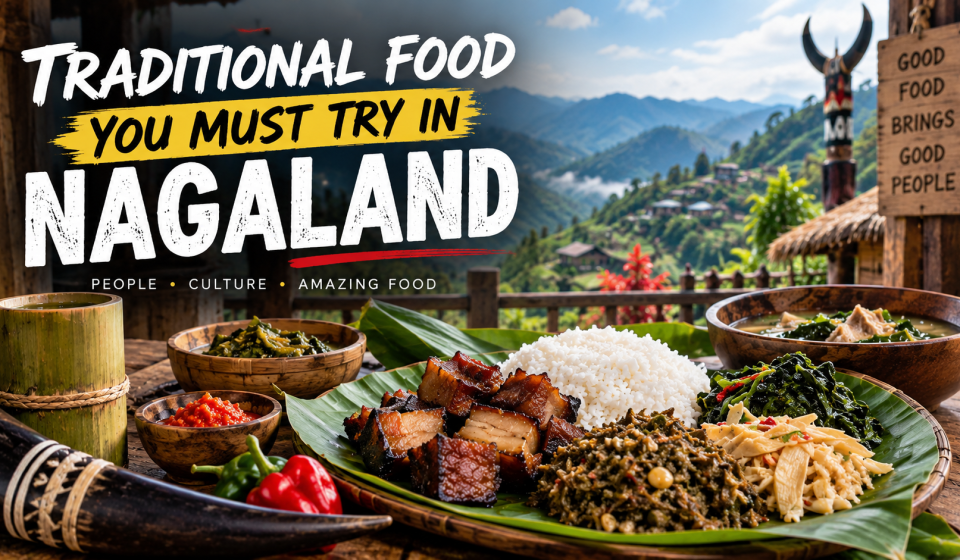

If you travel to Nagaland and eat only familiar Indian food, you’ve missed a big part of the trip.
Naga food is built around smoked meat, fermented soybean, bamboo shoot, leafy greens, rice and seriously hot chillies. The cooking can look simple, but the flavours have plenty going on.
And there’s a good reason food varies from one place to another. Nagaland is home to several Naga communities, each with its own food traditions and favourite preparations.
So, what should you actually eat?
Smoked pork with axone
Start here.
Smoked pork cooked with axone, fermented soybean, is one of the dishes most closely associated with Naga cooking. The pork gets a deep smoky flavour, while axone brings a strong fermented taste that takes a little getting used to.
Sümi cuisine is particularly known for smoked pork with axone. If you’re staying in Kohima or visiting Kisama, this is one dish I’d put near the top of the list.
Have it with rice. You’ll want something plain beside it.
Pork with bamboo shoot
Bamboo shoot turns up everywhere in Naga cooking.
Fresh, dried and fermented bamboo shoots are used in different preparations, and their sour, earthy flavour works especially well with pork. The Ao Naga food served at Kisama includes pork with bamboo shoot as one of its traditional dishes.
The flavour is sharp enough to wake up a plate of rice.
If you’ve never eaten bamboo shoot before, this is a good place to start.
Anishi
Anishi is one of the more unusual foods you’ll come across.
It’s made from fermented taro leaves, which are formed into patties and then smoked or sun-dried. In Ao cooking, anishi can be cooked with dried pork or dried fish.
There’s a smoky, fermented character to it that feels very different from the usual curries you might know.
Try it when you get the chance. This is the kind of food that tells you something about how local ingredients were preserved and cooked long before modern refrigeration.
Rosup
Rosup is an Ao Naga dish made with mixed vegetables, dry fish and bamboo shoot.
It sounds humble. It tastes like the sort of thing you’d happily eat after a long day in the hills.
The Ao Morung at Kisama lists Rosup among its traditional dishes, along with pork, bamboo shoot preparations and fish cooked in bamboo tubes.
If you’re travelling with someone who doesn’t eat much meat, ask about vegetable dishes like this.
Fish cooked in bamboo
This one is as much about the cooking method as the fish.
Fish is cooked inside bamboo tubes, giving the dish a subtle earthy aroma while keeping the fish moist. The preparation is served as part of the traditional Ao menu at Kisama.
And yes, eating food cooked inside bamboo while sitting in Nagaland feels exactly as good as it sounds.
Naga king chilli
You can’t talk about Naga food without mentioning the Naga king chilli.
It’s famous for its heat, but don’t treat it like a challenge unless you’re very sure of yourself. King chilli is used in pickles, chutneys and other local preparations, and Nagaland’s government sources list king chilli products among the state’s local foods.
A little can change an entire plate.
A lot can make you question your life choices.
Green vegetables with axone
Axone isn’t reserved for pork.
Sümi cuisine also includes green vegetables with arum, along with ginger and axone chutney. These dishes show how fermented soybean works across different ingredients rather than being tied to one particular meat preparation.
If you want something lighter between plates of smoked meat, this is worth ordering.
Amrusu
Amrusu is another traditional Ao dish served at the Ao Morung in Kisama.
The dish is part of a food tradition where rice, vegetables, meat, fish, bamboo shoot and locally preserved ingredients are combined in practical, filling meals.
Ask what’s being served that day rather than assuming every restaurant will prepare it the same way.
That’s half the fun with traditional food in Nagaland.
Rice is the constant
Rice is the staple around which many Naga meals are built.
You’ll usually find it alongside meat, vegetables, bamboo shoot, fermented foods or local greens. Tourism Nagaland also points to fresh and edible wild leaves and herbs as part of local cooking.
So don’t expect every meal to arrive as a giant plate of curry and naan.
A Naga meal can be much simpler: rice in the middle, a few strongly flavoured sides, and something smoky or fermented doing the heavy lifting.
Where to try traditional Naga food
Kisama Heritage Village near Kohima is an easy place for visitors to start, especially around the Hornbill Festival.
The Naga Heritage Village has traditional morungs representing different Naga communities, and food courts form part of the complex. During the Hornbill Festival, local cuisine is one of the festival activities.
You’ll get a chance to compare dishes from different communities rather than treating “Naga food” as one single cuisine.
For a more personal experience, look at village homestays and local kitchens. Tourism Nagaland specifically promotes homestays where visitors can experience local cooking and daily life.
A few things to know before you order
Naga food can be very spicy.
If you’re sensitive to chilli, say so before your food arrives. And if someone offers you a dish containing axone, expect a strong fermented aroma. That’s part of the food, not a mistake in the kitchen.
Also, don’t judge a dish by how it looks.
Some of the best Naga food is quite plain-looking. The flavour comes from smoking, fermentation, bamboo shoot, fresh greens and the quality of the ingredients.
My Naga food shortlist
If you’ve only got a few meals in Nagaland, I’d start with:
- Smoked pork with axone
- Pork with bamboo shoot
- Anishi
- Rosup
- Fish cooked in bamboo
- Green vegetables with axone
- Naga king chilli chutney or pickle
And leave room for rice. You’ll need it.
The best way to eat in Nagaland is to order something you’ve never tried, ask what it contains, and let the local cooking do the talking.
Featured Image Credit: Generated/Sourced via Chatgpt.com.
Editorial note: Some articles may use AI-assisted research or drafting. Our editorial process includes human review and editing, and important travel information should be verified with official sources before your trip.
Travel Tips & Responsible Exploration
Good travel planning starts with staying informed. Before your journey, verify important details such as transportation, accommodation, weather, permits, entry requirements, and local guidelines. Respect local communities, cultures, traditions, and the environment, and travel responsibly wherever you go. Suman Rabha shares practical travel guides, local insights, and destination information to help readers explore Northeast India and beyond with greater confidence.